LEAPS Model of Communication
- Assignment Blog
- Jun 01, 2026
- Study Skills
The LEAPS model of communication is widely recognized as a highly effective framework for enhancing interpersonal communication in both social and educational contexts. It is particularly useful for situations that involve sharing instructions, managing deadlines, providing feedback, or navigating complex discussions. By following the LEAPS approach, individuals can foster clearer understanding, reduce misunderstandings, and improve collaboration.
In this blog, we will explore 5 ways the LEAPS model can instantly improve your communication skills, providing practical insights for students, educators, and professionals alike. Whether you’re giving feedback, managing assignments, or engaging in workplace discussions, LEAPS offers a structured path to more meaningful and impactful communication. Here you can ask any Assignment Help online for your academic assistance.
Want to understand the LEAPS Model of Communication? Connect with Study Assignment Help experts for a step-by-step guide and gain the knowledge needed to improve your academic assignments and achieve better grades!
What Is the LEAPS Model of Communication?
The LEAPS model of communication is a structured approach designed to improve understanding, strengthen relationships, and reduce misunderstandings during conversations. Originally developed as a conflict-resolution and communication tool, it is now widely used in education, healthcare, counseling, social care, and professional environments.
The model provides a clear, step-by-step framework that helps individuals listen actively, understand different perspectives, respond thoughtfully, and build more effective communication. As a result, the LEAPS model is particularly valuable for students, educators, and professionals who need to communicate clearly, provide feedback, and collaborate successfully.
Read Blog: Most Engaging Communication Research Topics for Students
What Does LEAPS Stand For? Let's Breakdown of Each Component
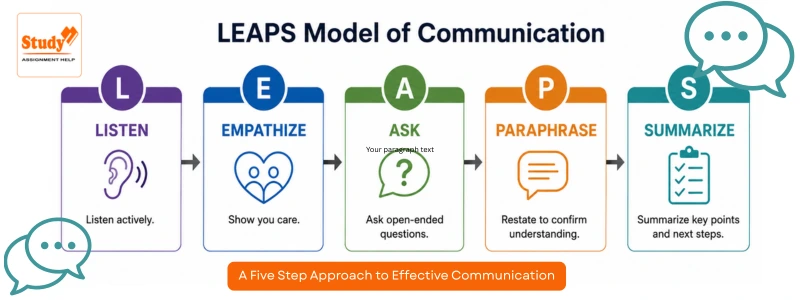
These listening and communication skills are as follows:
Listen Actively to Understand, Not Just Respond (L): This listening involves focusing on the whole attention of someone or the speaker. Here, misunderstandings often occur when people listen to respond rather than to understand. Here, you always need to keep this in mind while following the given instructions. You also need to listen to the instructions very carefully. The entire explanation needs to be approved by your teachers. This approach will always encourage pace, reduce assumptions, and ensure that the key academic details are not missed during discussions. Thus, active listening skills are very important and a necessary step in the leaps model of communication.
Empathize to Build Stronger Connections (E): empathy in communication is very much needed. Empathy is very much essential during the communication process. The pressure of learning with tone and clarity. The leaps model encourages the improvement of communication skills by acknowledging emotions without judgment. If you understand the phrase carefully, it will help reduce tension. The ages are mostly unclear in the discussion. This shows respect for students' emotions and is essential to ensuring that all students are well supported in understanding their academic learning.
Ask the Right Questions for Clarity (A): Asking questions is one of the best communication strategies at work. Most academic issues stem from vague expectations. The leaps model of communication supports the use of open and closed questions. The open questions are quite valuable in raising the most critical needs with proper feedback. This needs to be done before any misconceptions develop. This also indicates a genuine willingness to understand the assignment issue.
Paraphrase to Avoid Misunderstandings (P): A proper paraphrasing always allows the masses to be correctly interpreted. It needed good rewording of the correct information, in your own words. If you successfully rephrase all the needed data and information as an effective part of the communication model, it will be regarded as a communication theory of the LEAPS. If you rephrase the assignment information, you can repeat it as the tutor provided it to ensure its accuracy. Rephrasing concerns allows your tutor to restate all the content students read to ensure their understanding.
Summarize to Ensure Clear Outcomes (S): The process of summarization can lead to a communication closure. This process is used to identify the main highlights and how to move forward in any communication. The leaps model of communication always closes with a summary to eliminate any confusion. Summarization is an effective method to promote agreement on the follow-up process that concerns the preceding communication. This is done spirally in the case of online communication for various academic purposes.
Ready to master the LEAPS Model of Communication? Let our Study Assignment Help experts guide you!
Why Most Communication Fails (And How LEAPS Fixes It)
Most communication fails because of a perception gap and the invisible instance between what you intend to say and what the listener is interested in. This is explained below:
- The Reply Trap: Here, most people listen to the response rather than to understand. While someone is speaking, we can formulate our next argument by missing the core meaning of the message.
- The Knowledge Curse: If you know already what you mean, you can leave the context out. Now, you can communicate from your own perspective to meet the listener.
- Defensiveness: It happens when the feedback is delivered with judgment, and the listener's brain shuts down by blocking any good exchange of ideas.
- Assumptions: Fill in the blanks of self-dent or bad internet, while communication is a vague idea.
How does LEAPS Fix the Interpersonal Communication Skills? (Examples)
Listen Actively (L): here you are giving the speaker your good attention. You always need to set aside your own personal agenda and focus wholly on the message they are transmitting, without planning any counterargument.
Empathize (E): acknowledge the emotion of the other person as well as their perspective. Here, you need to validate how they are feeling, even if you disagree with their statements. This will de-escalate tension by neutralizing the brain's defense mechanism.
Asking Questions (A): you always need to replace the stem with a very open-ended inquiry. Rather than saying it negatively, you can ask positively. This will shift the other person's mentality from defensive to analytical.
Paraphrase (P): Repeat the core message of the speaker back to them in your own words. This will always ensure that you can grasp the basic concept correctly and prove your real emotions to your listener, whom you are paying the most attention to.
Summarize (S): after you reach the clarity of all the essentials and facts, you need to get a conversation together in a brief and concise statement. This final step establishes a shared baseline before moving forward with the team for the final execution.
Master the LEAPS Model of Communication
Step-by-Step Academic Guidance from Experts
Common Mistakes When Using the LEAPS Model
The investors use the Leaps model for many stock exposures. These might contain certain mistakes, as follows:
- Ignoring Vitality or Vega: the leaps model is very sensitive to the implied vitality. If you buy while the vitality is high and get a drop before the expiration, it can destroy the premium even if the stock price triggers.
- Ignoring the Dividends: the Leap does not pay the dividends. Thus, you can miss out on commanding passive income.
- Buying Outdated Money (OTM) Context: the OTM leaps are cheap but can lead to time decay and volatility.
- Communication and De-Escalation Framework: the leaps communicator model is used in the fields of management, law, as well as conflict resolution, as a structured 5-step process for building up trust and removing all kinds of misunderstandings.
- Waiting for a Long Time to Respond: the first step of this model is proper listening, which means absolutely clearing your mind and focusing fully on the words of the speaker, as well as his body language. People often make a mistake here by planning the ext. argument while the other person is still talking.
- Too Much Empathizing with the Agreeing Point: empathizing is about understanding the perspective of the other person, or not agreeing with any bad behavior.
- Asking a Lot of Questions: Asking is the third step of the LEAPS communication model. Thus, if you ask “why,” it can make a defensive person feel more interrogated. Rather, rely more on the open-ended questions like “where,” “how,” and “what” to gather all the necessary information.
- Rushing to the Procedure: the leaps communication model is a sequence of the process of paraphrasing and summarizing, which helps ensure you understand the message accurately before you can try to solve the problem. Here, if you rush straight to the problem-solving part, it will validate the speaker's feeling.
Read More: 10 Professor-Approved Research Methods Used in UK Psychology Studies
The Origin and Background of the LEAPS Model of Communication
The LEAPS Model is a communication framework designed to improve interpersonal interactions through active listening, empathy, and respectful dialogue. It emerged as a practical approach for handling difficult conversations, resolving conflicts, and strengthening understanding between individuals in both professional and personal settings.
Over time, communication experts and educators have adopted LEAPS as a structured method for promoting constructive discussions, particularly in situations where emotions, disagreements, or misunderstandings may arise. The model emphasizes listening before responding, allowing participants to better understand perspectives and concerns before offering solutions or opinions.
Today, the LEAPS framework is widely used in education, workplace communication, counseling, leadership development, customer service, and conflict resolution settings because of its ability to encourage meaningful and productive conversations.
Key Features and Principles of the LEAPS Communication Model
The LEAPS Model is built on several fundamental principles that make communication more effective and collaborative:
- Provides a clear and systematic approach to conversations.
- Encourages active listening and genuine understanding.
- Promotes empathy and emotional awareness.
- Reduces defensive reactions and communication barriers.
- Fosters mutual respect and trust among participants.
- Helps individuals focus on understanding issues before formulating responses.
- Supports constructive conflict resolution and problem-solving.
- Improves relationship-building through open and respectful dialogue.
Applications of the LEAPS Model
The LEAPS Model is commonly applied in environments where effective communication is essential and play a vittal role. In academic settings, it helps students participate more confidently in classroom discussions, group projects, and presentations etc. Educators also use the framework to create inclusive learning environments where different viewpoints can be shared respectfully.
Beyond the education, this model is frequently used in customer relations, healthcare, counseling, mediation, leadership and workplace communication to enhance collaboration, reduce misunderstandings, and achieve better outcomes through effective dialogue.
Need help with your academic assignments? Our expert writers provide reliable assistance across a wide range of subjects, including Nursing, Management, MBA, Healthcare, Leadership, and Communication Studies. Whether you're working on an essay, case study, report, or dissertation, we can help you submit high-quality work and achieve better grades.
How to Start Using LEAPS in Your Daily
Conversations Today
- If we start by using the LEAPS communication framework of listen, empathy, ask, paraphrase, and summarize today, by listening to your inner monologue, by repeating the main points of the speaker in your own words to confirm your own understanding, as well as addressing the conflict in a collaborative manner rather than using arguments.
- If you transition from the theory to the daily practice, you do not need to overhaul your entire communication style overnight. Here, you can also seamlessly integrate your communication mode into your daily work and communication with a few intentional changes. The following are the ways to implement leaps in your daily interactions:
- Let us start with L, which is the listening part, and e, which is the empathize part. If a friend, colleague or a family member comes to you with any complaint or story you intentionally go to the listening switch. Put away all devices, such as TVs and smartphones. After they finish, you can acknowledge their feelings. Even if you do not agree with them, you can still empathize with them by saying, “I understand how frustrating you feel regarding this matter.”You can de-escalate their tension in this way.
- Discussing the A ask and the P paralogues part can directly solve the problem. Here, you can ask all types of open-ended questions, like " Can you tell me what really happened? Then, they will answer your question. After that, you need to paraphrase their words back to them in your own words, like “Oh, I can understand your concern. ”This ensures that you are not misinterpreting their intention and shows how much you care for them.
- You always need to conclude with the S or the summarising part before finishing the discussion. Here, you need to provide a summary of the entire conversation to establish the upcoming steps. This is a kind of recapping that shows that you have really achieved a mutual understanding.
- Always try to habitually choose one daily scenario for practicing the LEAPS communication model. Like meeting a friend, a team meeting, or a get-together in any local café.
You can always follow the communication skills tips mentioned above on how to improve communication skills in daily life routine communications.
Tips for Good Communication:
- Active Listening: It is always one of the best practices to improve communication skills.
- Keep it Concise: keeping your communication concise, with not more than 2-3 sentences, can make it more effective as well as appreciating your listeners.
- Read the Room: always be cozy regarding the present situation in your room while you are delivering your speech. You need to read and validate the other people's answers and integrate them within the room
The tips mentioned above can greatly improve your comprehension skills.
Need more clarity on LEAPS? Our tutors make learning simple and effective.
Conclusion & Final Thoughts: Small Changes, Big Communication Impact
Effective communication is always necessary in the context of your higher education. The leaps model of communication is both practical and people-centered.
This method will always help you in having a very good clarity without any rigid approach. Every small detail, like listening, questioning, and summarizing, can yield better results. This can boost people's confidence and lead to smoother, more trustworthy academic interactions.
The leaps communication model is always very helpful in communication for the students since it promotes better academic understanding. This method also works very well in modern digital communication systems, such as email, online chat support and socila media platforms.
The laps communicator model is not as time-consuming as it seems. Initially, it can feel like it is moving very slowly, but later on, it saves a lot of time by removing all sorts of confusion.
Thus, you can see in this blog that writing a good assignment paper by following the leaps model of communication accurately is not an easy job. Thus, you always need the best online Business Communication Assignment help service provider. The studyassignmenthelp.co.uk is the best choice for you in this regard.
Why StudyAssignmentHelp.co.uk?
- We are always the one provider of the online Business Management Assignment Help service
- 24/7 hours of online help and support are provided via our website
- A hundred percent plagiarism-free service is probed by us
- A hundred percent error-free service is provided by us
- Top grades are always assured by us
- Our experts carry out a lot of research, experiments, and analysis to write the top-standard assignment for you
- The assignments are always provided as per the unique needs of your college or university
- Only customized services are provided by us
Our Worldwide clients are very happy and satisfied with our services. Thus, join us soon.